The real cost of that reactive approach isn't just the catch-up work. It's every decision made without accurate data, every tax dollar left on the table, and every opportunity missed because the numbers weren't there when they needed to be.
This article focuses on the measurable advantages of ongoing, year-round bookkeeping — not what bookkeeping is in theory, but what consistent, monthly recordkeeping actually does for a small business's financial health and growth.
Key Takeaways
- Ongoing bookkeeping gives you current cash flow data — so you catch problems before they become crises
- Consistently recorded expenses mean fewer missed deductions and cleaner records when the IRS comes calling
- Month-over-month financial data makes growth decisions faster, better-informed, and more credible to lenders
- According to a Clutch survey, 45% of small businesses don't employ an accountant or bookkeeper — leaving most without the financial visibility they need
- Clean, consistent records reduce your tax prep costs — and your stress — every single year
What Is Ongoing Bookkeeping?
Ongoing bookkeeping is the regular recording, categorization, and reconciliation of every financial transaction your business makes — income, expenses, invoices, payroll, and bank activity — as those transactions happen throughout the year.
That last part matters. The defining feature isn't what gets recorded, it's when. Ongoing bookkeeping captures data in real time, not months after the fact.
How It Differs from Seasonal or Reactive Bookkeeping
Reactive bookkeeping reconstructs a year's worth of transactions under deadline pressure. Ongoing bookkeeping maintains a live, accurate financial record that reflects where the business actually stands — today.
Modern accounting platforms like QuickBooks make this practical even for small teams. Bank accounts sync automatically, transactions categorize as they clear, and business owners can pull an accurate financial snapshot at any point without waiting for an accountant to piece it together at year-end.
The goal of bookkeeping isn't the records themselves — it's the financial clarity and control those records make possible. Businesses that maintain books consistently make decisions from accurate data, not end-of-year estimates.
Key Advantages of Ongoing Bookkeeping for Small Businesses
Each advantage below ties directly to outcomes small business owners track: cash flow, tax liability, decision quality, risk exposure, and access to capital.
Advantage 1: Real-Time Cash Flow Visibility and Control
When bookkeeping is maintained continuously, your cash flow position is never more than a few days out of date. You know what's coming in, what's going out, and when gaps are forming — before they become emergencies.
The Federal Reserve's 2025 report on employer firms found 51% of small businesses cited uneven cash flows as a financial challenge, and 56% struggled to cover operating expenses. These aren't fringe problems — they're the baseline reality for most small businesses operating without current financial data.
A business owner with current cash data can:
- Spot a cash gap two weeks out and delay a major purchase
- Identify a client whose invoices are consistently 45+ days late
- Confirm there's enough runway to hire before making an offer
- Avoid overdrafts during slow seasons by planning around them
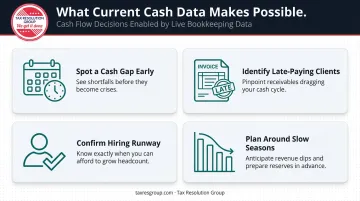
Without ongoing bookkeeping, all of those decisions rely on memory and estimates. That's a structural disadvantage — one that quietly compounds every quarter the books stay out of date.
KPIs this affects: days cash on hand, accounts receivable turnover, accounts payable aging, monthly burn rate, invoice collection time
When it matters most: During rapid growth, seasonal revenue swings, or any period when the business is considering taking on debt. These are precisely the moments when an unexpected cash shortfall carries the highest operational cost.
Advantage 2: Tax Readiness, Captured Deductions, and Reduced Audit Risk
When transactions are recorded and categorized throughout the year, every deductible expense is documented at the time it occurs — not reconstructed from incomplete memory or a shoebox of receipts the week before your filing deadline.
The IRS is clear on this: the burden of proof to substantiate deductions and entries rests with the taxpayer. When records are disorganized or missing, deductions get disallowed — not because the expense didn't happen, but because it can't be proven.
The penalty exposure isn't trivial either. The IRS accuracy-related penalty is 20% of the tax underpayment attributable to negligence or disregard of tax rules. On a meaningful underpayment, that adds up fast.
Ongoing bookkeeping reduces this risk in two ways:
- Captures deductions when they occur — before the receipt is lost or the context is forgotten
- Maintains records that align with IRS documentation standards — sales slips, invoices, receipts, deposit slips, and bank records all reconciled to the ledger throughout the year
When a firm like Tax Resolution Group handles both bookkeeping and tax services for the same client, there's a direct operational benefit: the tax team reviews categorized, current data on a quarterly basis instead of untangling a year's worth of transactions under deadline. Reviewing clean, categorized records quarterly — rather than scrambling at year-end — is where miscategorized expenses get corrected and legitimate deductions don't fall through the cracks.
KPIs this affects: effective tax rate, deductions claimed, penalty and interest exposure, time spent on year-end tax preparation
When it matters most: Businesses with high transaction volumes, significant contractor or vendor payments, or multiple income streams — where the risk of miscategorization is highest and the cost of errors is greatest.
Advantage 3: Data-Driven Decisions and Growth Readiness
A business with consistent monthly bookkeeping has something most small businesses lack: a reliable financial history. Month-over-month income statements, expense trends, and cash flow patterns make planning decisions far more grounded than gut instinct allows.
Those records aren't just for tax purposes. They answer practical questions:
- Which service line actually generates the highest margin?
- Where are operating costs trending upward?
- Is the business moving toward or away from its quarterly revenue targets?
This matters beyond internal planning. The Federal Reserve's 2025 Small Business Credit Survey found 37% of small employer firms applied for financing — and among them, 24% received none of what they sought. Lenders evaluate repayment ability based on documented cash flow and financial history. The SBA requires financial statements to assess creditworthiness for 7(a) and 504 loan applicants.
What clean records make possible:
- Producing income statements, balance sheets, and cash flow statements on demand
- Presenting a credible financial picture to lenders, partners, or potential buyers
- Avoiding weeks of catch-up work at the exact moment speed matters most
Tax Resolution Group produces these reports for clients on a monthly or quarterly basis — profit and loss statements, balance sheets, cash flow analyses, and accounts receivable aging reports — delivered through a secure client portal and reviewed in scheduled meetings. When a financing opportunity or partnership conversation arises, the financial history is already there, not something to reconstruct under pressure.
KPIs this affects: gross profit margin, operating expense ratio, revenue growth rate, loan application readiness, business valuation accuracy
When it matters most: Any moment where financial credibility affects the outcome — loan applications, bringing on a partner, expanding operations, or preparing for an eventual sale.
What Happens When Bookkeeping Is Treated as Seasonal
The pattern is familiar: a business engages bookkeeping support in March, gets taxes filed, and doesn't think about it again until the following February. For 9 to 10 months, transactions go unmonitored.
By the time problems surface (an overdraft, a missed deduction, a reconciliation error compounding for six months), the cost to fix them is significantly higher than consistent maintenance would have been.
The consequences follow a predictable sequence:
- Cash flow blind spots trigger reactive borrowing or missed opportunities
- Unrecorded expenses result in deductions that can't be substantiated at filing time
- Accumulated errors make financial statements unreliable for planning or lender review
- A single audit or financing request exposes months of disorganized records at the worst possible time
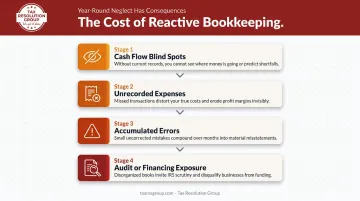
Each of those consequences compounds the next. The longer consistent bookkeeping is deferred, the more expensive and time-consuming catch-up becomes — in both direct fees and lost opportunity.
Clutch's 2026 survey found 45% of small businesses don't employ an accountant or bookkeeper at all. Most of those businesses aren't choosing chaos intentionally — they just haven't yet felt the full cost of operating without current financial data.
How to Get the Most Value from Ongoing Bookkeeping Services
Ongoing bookkeeping delivers the highest return when it's treated as an active management tool, not a passive filing system. That means reviewing financial reports regularly and acting on what they show.
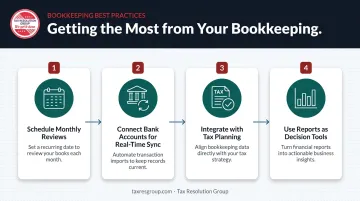
What maximizes value in practice:
- Schedule monthly financial reviews with your bookkeeper or accounting firm so that trends are discussed, not just documented
- Connect your bookkeeping system to your bank accounts so transactions sync in real time — platforms like QuickBooks make this straightforward and eliminate manual data entry
- Integrate bookkeeping with tax planning so that quarterly estimated tax payments are based on current data, not last year's numbers
- Use your financial reports as decision tools : margin analysis, expense trend reviews, and cash flow projections should drive monthly decisions, not collect dust
For small businesses in Huntington Beach and throughout California, Tax Resolution Group combines bookkeeping with tax consulting under one engagement. The same team that maintains your records also handles quarterly tax estimates and year-end strategy, eliminating the coordination gap that forms when bookkeeping and tax services sit with separate vendors.
Consistency is what makes this work. Clean financial data compounds in value the longer it's maintained — gaps in the process don't just pause the benefit, they erase the foundation you've built.
Conclusion
Ongoing bookkeeping gives small business owners something that year-end cleanups never can: consistent control over cash flow, tax exposure, and financial decisions before they become costly ones.
Its value is cumulative. Each month of consistent records makes the next financial decision faster, the next tax season less stressful, and the next opportunity easier to act on with confidence. Businesses that treat bookkeeping as a year-round practice tend to weather downturns more steadily, qualify for financing more easily, and make growth decisions with actual numbers behind them — not estimates.
The shift is straightforward. Build bookkeeping into your regular operations — or work with a firm like Tax Resolution Group that handles it for you — and your financial picture stops being a source of stress and starts being a tool you actually use.
Frequently Asked Questions
How does having a bookkeeper benefit a small business owner?
A bookkeeper handles the ongoing recording, reconciliation, and categorization of every transaction — freeing the owner's time while ensuring accurate, current financial data is always available. That means better decisions, fewer surprises, and a smoother tax season.
What are the three golden rules of bookkeeping?
The three principles cover personal accounts (debit the receiver, credit the giver), real accounts (debit what comes in, credit what goes out), and nominal accounts (debit expenses and losses, credit incomes and gains). Together, they ensure every transaction has a matching entry on both sides of the ledger.
How often should a small business update its books?
Most small businesses benefit from weekly transaction recording and monthly reconciliation. The higher your transaction volume, the more frequently records should be updated — waiting longer creates gaps that are harder and costlier to reconstruct accurately.
What is the difference between ongoing bookkeeping and just doing books at tax time?
Tax-time bookkeeping is retroactive — it reconstructs an entire year's transactions under deadline pressure, which is error-prone and expensive. Ongoing bookkeeping maintains accurate records throughout the year, enabling real-time decisions and a far cleaner tax preparation process.
How can ongoing bookkeeping help a small business secure financing?
Lenders require documented financial history to evaluate repayment ability. Businesses with consistent bookkeeping can produce income statements, balance sheets, and cash flow statements on demand — which directly strengthens loan applications and supports more accurate business valuations.