
The pricing gap is that wide because bookkeeping isn't a commodity. What you pay depends on who handles your books, how complex your finances are, and what services you actually need. Many owners discover too late that they've been underserved by a bargain provider or overpaying for services they won't need for another two years.
AI-assisted bookkeeping tools are also reshaping the market. According to Intuit's 2025 survey, 81% of accountants reported AI improved their productivity — which is gradually being passed through to clients as lower entry-level pricing. At the same time, experienced bookkeepers remain scarce, keeping rates for higher-skill work elevated.
This guide breaks down what small businesses should actually expect to pay in 2026, the factors that drive costs up or down, and how to figure out what level of service your business genuinely needs.
Key Takeaways
- Monthly bookkeeping costs range from $99/month for basic online services to $4,000+/month for a full-time in-house hire
- Transaction volume and scope of services are the two biggest price drivers
- Flat monthly fees work best for most small businesses; hourly billing suits occasional or one-off needs
- Cleanup and catch-up bookkeeping are priced separately; budget $1,000–$3,000 for historical reconstruction
- Cheap bookkeeping often costs more long-term through errors, IRS penalties, and missed deductions
How Much Does Bookkeeping Cost for a Small Business in 2026?
Bookkeeping doesn't have a fixed price tag. Two businesses in the same industry can face dramatically different costs based on who they hire, what those providers include (and exclude), and how complex the books actually are.
Many owners compare quoted monthly rates without accounting for what's excluded. Tax filing, payroll, cleanup fees, and software subscriptions can push the real number significantly higher than the base price suggests.
Freelance Bookkeeper
Freelance bookkeepers typically charge by the hour. BLS May 2025 data for bookkeeping clerks (SOC 43-3031) shows:
- 10th percentile: $16.60/hr
- Median: $24.00/hr
- 90th percentile: $36.90/hr
Hourly billing works well for occasional help or one-time projects. The risk is unpredictability — scope creep, disorganized records, or unplanned cleanup work can push monthly bills well beyond expectations.
Online/Outsourced Bookkeeping Services
This is the most common choice for small businesses wanting predictable costs. Flat-fee tiers from major providers currently look like this:
| Provider | Entry Tier | Mid Tier | Notes |
|---|---|---|---|
| Pilot | $99/mo (Essentials) | Custom pricing | Up to $100K monthly expenses |
| Bench | $199/mo (Grow) | $399–$599/mo | Under $250K annual revenue for entry tier |
| Bookkeeper360 | $399/mo (Monthly) | $599/mo (Weekly) | Dedicated accounting team |
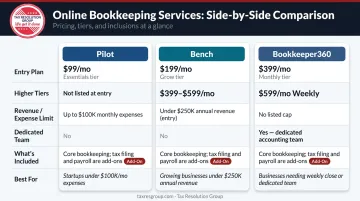
Entry-level plans typically include transaction categorization, bank reconciliation, monthly close, and basic financial reports. Tax filing, payroll, and CFO-level advisory are almost always add-ons.
In-House Bookkeeper
A full-time bookkeeper costs significantly more than most owners budget for. The BLS median annual wage for this role is $49,920 — or $4,160/month before benefits. Factor in BLS's March 2026 finding that benefits represent 30.1% of total employer compensation costs, and you're looking at closer to $5,950/month fully loaded.
That figure also doesn't include software subscriptions, equipment, or training.
Project-Based / Cleanup Bookkeeping
If your books are behind, expect a separate one-time fee before any ongoing service starts:
- Bookkeeper360: from $1,000/project for onboarding and prior bookkeeping
- Bench: $1,200 onboarding plus $55/hr for a QBO Certified Bookkeeper
- Complex historical reconstruction on Upwork: $1,000–$3,000
Cleanup costs depend on how far behind the books are and how complex the reconstruction is. Once you understand these baseline numbers, the next step is identifying which cost factors apply to your specific business.
Key Factors That Affect Bookkeeping Prices
Beyond service type, several business-specific variables determine where your costs land within any given range.
Business Size and Transaction Volume
Transaction volume is the primary pricing lever for flat-fee services. A sole proprietor with 50 monthly transactions pays a fraction of what a business with multiple employees, several accounts, and hundreds of monthly entries will pay.
Pilot prices by monthly expenses (Essentials covers up to $100K/month). Bench uses annual revenue bands. QuickBooks Live Bookkeeping recalculates pricing every three months based on average monthly expenses. Regardless of which provider you choose, expect your rate to climb as transaction volume grows.
Scope of Services Required
Basic bookkeeping covers:
- Transaction categorization
- Bank reconciliation
- Monthly financial reports
Expanded bookkeeping adds:
- Payroll processing
- Accounts payable/receivable management
- Tax preparation support
- More detailed financial reporting
Each addition increases cost. Working with a firm that offers bookkeeping alongside tax services — like Tax Resolution Group — can reduce total spend compared to hiring a standalone bookkeeper and a separate tax preparer. The two services inform each other, and consolidated oversight reduces the risk of errors slipping through.
Bookkeeper Experience and Credentials
Certified bookkeepers — credentialed through the American Institute of Professional Bookkeepers, which requires at least 2 years of full-time experience or 3,000 hours part-time — command higher rates. So do specialists with deep knowledge of specific industries.
The premium is worth it where errors are expensive. A bookkeeper who understands construction job costing or entertainment royalty accounting catches problems a generalist misses entirely.
Industry Complexity
Some industries require specialized bookkeeping knowledge that increases both scope and cost:
- Construction: Job costing, project profitability tracking, retention tracking, and progress billing require expertise well outside standard bookkeeping
- Nonprofits: Restricted fund tracking and grant compliance require separate accounting treatment
- Media and entertainment: Royalty accounting and project-based income tracking require industry-specific familiarity
For context, industry-specialized firms handle work like cabinet project costing, granite slab tracking, and contractor retention — details that fall outside a general bookkeeper's scope entirely.
Geographic Location
Location affects in-house hiring costs considerably. BLS May 2025 data shows median hourly wages for bookkeeping clerks ranging from:
- District of Columbia: $28.00/hr ($58,240/year)
- California: $27.00/hr ($56,160/year)
- Mississippi: $19.00/hr ($39,520/year)
- West Virginia: $20.00/hr ($41,600/year)
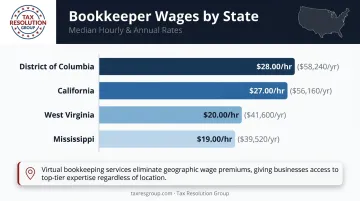
Virtual and online services largely eliminate this variable — you're not paying a California wage premium when outsourcing to a remote provider.
Pricing Models: How Bookkeepers Charge
Three structures dominate the market:
Flat monthly fee — Services are tiered by transaction volume or monthly expenses, so you know exactly what you'll pay each month. Best for businesses with consistent, recurring bookkeeping needs.
Hourly — Flexible, but scope creep and unplanned work can inflate bills fast. Better suited for occasional or variable-scope projects, not ongoing monthly books.
Project-based — Used for one-time engagements: catch-up bookkeeping, onboarding into a new accounting system, or historical reconstruction. Priced by complexity and how far behind the records are, typically ranging from $1,000 to $3,000+.
Flat monthly subscriptions are the practical choice for most small businesses. The cost is predictable, services are clearly defined, and there's no risk of a surprise invoice because a month was unexpectedly complicated.
Low-Cost vs. High-Cost Bookkeeping — What's the Difference?
Not all bookkeeping services deliver the same outcome. The cheapest option often looks attractive — until an error triggers a penalty or a lender rejects your loan application.
Here's where budget and premium options genuinely diverge:
| Factor | Budget Option | Premium Option |
|---|---|---|
| Accuracy | Higher error risk, generalist approach | Specialized review, lower error rates |
| Responsiveness | Limited communication, slower turnaround | Dedicated contact, faster response |
| Scalability | May not handle growth well | Scales with your business |
| Tax integration | Separate provider needed | Often integrated |
| Payroll/AP/AR | Usually add-ons or unavailable | Commonly available |
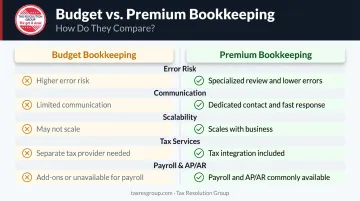
The long-term cost of under-investing in bookkeeping is concrete. The IRS imposes an accuracy-related penalty of 20% of the underpayment attributable to negligence or disregard of rules. A single year of undetected errors can generate penalties that dwarf what quality bookkeeping would have cost over the same period.
Clean, accurate books also directly support business financing. The SBA uses financial statements — balance sheets, profit and loss reports — as part of loan evaluations. Disorganized records don't just create tax risk; they can disqualify you from capital you otherwise qualify for.
What Most Small Businesses Get Wrong About Bookkeeping Costs
Ignoring the True Monthly Cost
The quoted bookkeeping fee is rarely the full number. A realistic example for a small business on a mid-tier outsourced plan:
- Outsourced bookkeeping (mid-tier): $399/month
- QuickBooks Online Plus subscription: $115/month
- Payroll add-on: $200/month
- Sales tax filing: $125/month
- Actual monthly cost: $839/month
That's more than double the advertised rate. Know exactly what's included before signing anything.
Buying the Wrong Tier
Two equally costly mistakes pull in opposite directions:
- Overbuying: Paying for full-service accounting when basic bookkeeping is sufficient at your current stage
- Underbuying: Choosing the cheapest tier, outgrowing it within months, and forcing a disruptive transition mid-year
A business with 80 monthly transactions and no employees doesn't need the same service level as one with $2M in revenue, five staff members, and multiple income streams. Match the service to where the business actually is, not where you hope it'll be.
Treating Bookkeeping as Pure Overhead
Accurate books aren't just a compliance obligation. They're an active business tool. Owners who underinvest here often discover the real cost later — not as a line item, but as a crisis.
Clean financials help you:
- Spot cash flow gaps before they become emergencies
- Identify margin problems by product, service, or client
- Qualify for financing (lenders require organized records)
- Respond to an IRS audit without scrambling for receipts
Catch-up bookkeeping to fix a year of neglected records can run $2,000–$10,000 or more. Prevention is the cheaper option.
Frequently Asked Questions
Is a bookkeeper cheaper than an accountant?
Yes. BLS May 2025 data shows bookkeeping clerks at a $24.00/hr median, while accountants and auditors (SOC 13-2011) come in at a $40.00/hr median. Bookkeepers handle day-to-day transaction recording; accountants handle financial analysis, tax strategy, and compliance.
What is the average monthly cost of bookkeeping for a small business in 2026?
Online outsourced services start around $99–$199/month for basic plans and run $400–$600/month for more comprehensive coverage. A full-time in-house bookkeeper costs $4,160/month in salary alone before benefits, software, and equipment are factored in.
How much does it cost to outsource bookkeeping for a small business?
Outsourced bookkeeping typically runs $200–$600/month for most small businesses, with more complex engagements reaching $2,000+/month. Outsourcing eliminates the overhead of a full-time hire and makes costs predictable.
When should a small business hire a bookkeeper?
Watch for these signs:
- Transactions are consistently recorded late or missed
- Errors are showing up in your financial records
- You're spending personal time on bookkeeping instead of running the business
What is the difference between basic bookkeeping and full-service bookkeeping?
Basic bookkeeping covers transaction recording, reconciliation, and monthly reports. Full-service adds payroll, accounts payable/receivable management, tax preparation support, and more detailed financial reporting — at a higher cost.
Can using accounting software reduce my bookkeeping costs?
Yes. Platforms like QuickBooks automate transaction categorization, bank syncing, and reporting, reducing the hours a bookkeeper spends on your account. With hourly providers, that directly lowers your bill. With flat-fee services, cleaner records may qualify you for a lower service tier.