Introduction
Picture this: your company's most critical leader announces their resignation on a Monday morning. No warning, no overlap period, no handover plan. The operations they managed, the client relationships they built, the institutional knowledge they held — gone overnight.
This scenario plays out more often than most organizations want to admit. According to Korn Ferry's 2025 annual report, 50% of CEO successions in 2024 were unplanned, up from 43% the year before.
This guide is for business owners, executives, HR leaders, and family business operators who want to get ahead of that risk. You'll learn what leadership development and succession planning actually mean, why the financial stakes are higher than most realize, how to build a working framework, and what the tax and valuation considerations look like when ownership eventually changes hands.
Key Takeaways
- Succession planning is a continuous business strategy — not a one-time document you file away
- Leadership development and succession planning must work as one connected system
- Poor planning destroys real financial value; proactive planning builds it
- Valuation, taxes, and buy-sell agreements all need attention well before a transition
- Starting years before a transition is the single biggest advantage any organization can have
What Is Leadership Development and Succession Planning?
Succession planning is the process of identifying and preparing employees to fill key leadership roles when current leaders retire, resign, or unexpectedly leave. Strategic is the key distinction here — it's not a reactive HR exercise triggered by a departure notice. It's a continuous discipline that treats leadership continuity as a core business function.
Leadership development is the ongoing investment in building the skills, competencies, and judgment employees need to step into larger roles. Where succession planning answers "who moves up," leadership development answers "how do we make sure they're ready."
The two are inseparable. A succession plan without leadership development is just a list of names — no preparation behind the promotions, and no confidence that the right person is actually ready when the moment arrives.
A few common misconceptions worth clearing up:
- Applies at every level where a departure disrupts operations — department heads, project leads, and specialized technical roles, not just the C-suite
- Matters most for small businesses and family-owned operations, which have fewer people to absorb the impact of a sudden vacancy
- Requires ongoing maintenance — business priorities shift, people leave, and any static plan quickly becomes obsolete
Why Succession Planning Matters for Your Business
The Financial Cost of Getting It Wrong
The numbers are stark. Research published by Harvard Business School found that poor CEO and C-suite succession planning destroys close to $1 trillion a year in market value among S&P 1500 companies. For family-owned businesses, McKinsey found an average 5.7 percentage-point decline in total shareholder return in the five years following a CEO transition — but a 23 percentage-point TSR increase when the transition was well-managed.
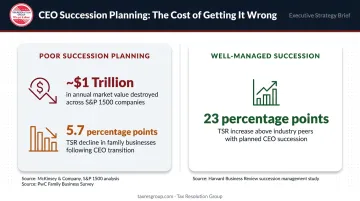
The disruption extends well beyond the departing leader: operations stall, clients grow uncertain, and competitors take notice.
Retention and Engagement
Gallup research found that organizations making a strategic investment in employee development report 11% greater profitability and are twice as likely to retain employees — clear evidence that visible growth paths drive loyalty.
When development opportunities are absent, people find them elsewhere — often taking institutional knowledge with them.
Institutional Knowledge Preservation
Senior leaders don't just hold titles. They carry client relationships built over years, operational nuances that never made it into documentation, and industry expertise that can't be replicated by a job posting. Three practical mechanisms protect this knowledge before a leadership transition occurs:
- Structured mentoring — pairing senior leaders with high-potential successors over time
- Shadowing programs — giving future leaders direct exposure to decisions and relationships
- Knowledge-transfer protocols — documenting processes, client context, and institutional history
Stakeholder Confidence
Investors and boards take succession planning seriously as a governance signal. BlackRock's 2026 U.S. proxy voting guidelines explicitly expect companies to maintain a robust CEO and senior management succession plan — and allow voting action when significant concerns arise. A visible, credible succession plan tells the market that leadership stability isn't an accident.
The Internal vs. External Cost Case
External hires cost more and tend to underperform. Matthew Bidwell's peer-reviewed research found external hires were paid approximately 18% more than internal promotions and received lower performance evaluations for their first two years. The promotion-from-within case isn't just cultural — it's a measurable financial advantage.
The 5 Steps of Effective Succession Planning
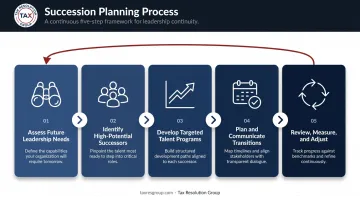
According to SHRM's research, only 21% of HR professionals say their organization has a formal succession plan. Here's how to build one that actually works.
Step 1 — Assess Future Leadership Needs
Start with strategy, not org charts. What does your business need to look like in five to ten years? Which leadership roles are critical to getting there? Factor in anticipated retirements, industry shifts, and growth projections. The goal is to define what kind of leadership the organization will require — before the vacancy appears.
Step 2 — Identify High-Potential Successors
Evaluate current employees across four dimensions:
- Performance history — consistent results over time, not just recent visibility
- Leadership capability — how they influence, communicate, and make decisions under pressure
- Cultural alignment — whether their values match where the organization is heading
- Growth trajectory — capacity to develop, not just current performance level
Avoid proximity bias. Employees who are most visible — physically present, frequently in meetings — tend to get noticed disproportionately. Structured evaluation criteria reduce that distortion.
Step 3 — Develop Targeted Talent Programs
Generic training doesn't prepare people for specific roles. Identified successors need:
- Mentorship from current role-holders
- Cross-functional assignments to build organizational breadth
- Stretch projects that expose gaps before they become crises
- Coaching focused on leadership behaviors, not just technical skills
The development plan should map directly to the gaps identified in Step 2.
Step 4 — Plan and Communicate Transitions
A transition plan without a timeline is wishful thinking. For each leadership handover, build in:
- Clear milestones with defined ownership at each stage
- Overlap periods so outgoing and incoming leaders can work in parallel
- Contingency scenarios for unplanned exits
Communicate proactively with clients, board members, and key stakeholders so transitions feel managed, not abrupt.
Step 5 — Review, Measure, and Adjust
Succession planning is a living document. Harvard Law School Forum guidance recommends the full board review the succession plan at least once a year. Track metrics like:
- Promotion rates from internal development programs
- Leadership bench depth (number of ready-now successors per critical role)
- Retention rates among high-potential employees
- Time-to-fill for leadership vacancies
When metrics plateau or decline, treat that as a signal to revise the plan — not just reaffirm it.
Building a Leadership Development Framework That Works
Without a formal framework, leadership development defaults to whoever gets noticed — not whoever is ready. A structured approach ties individual growth directly to organizational strategy, ensuring the people being developed can actually execute the company's vision when they step up.
Core Components of an Effective Framework
| Component | What It Does |
|---|---|
| Competency mapping | Defines the skills each leadership role requires |
| Individualized development plans | Aligns growth to specific role gaps |
| Mentoring and coaching programs | Accelerates readiness through direct knowledge transfer |
| Performance and readiness assessments | Provides regular checkpoints on progress |
Diversifying the Leadership Pipeline
Organizations with homogeneous leadership pipelines make worse decisions — not because of ideology, but because of how group thinking works. McKinsey's 2023 research found companies in the top quartile for ethnic diversity on executive teams had a 39% greater likelihood of financial outperformance. Actively identifying candidates from varied departments, backgrounds, and career paths isn't a compliance exercise — it's a performance advantage.
Using Data and AI to Improve Decisions
Bias is one of the biggest threats to succession planning quality. When selection is based on gut feel or personal familiarity, organizations routinely overlook strong candidates and promote the wrong people.
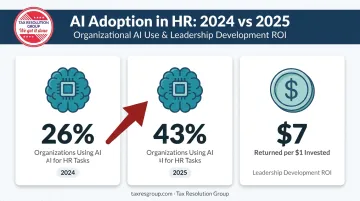
HR analytics and AI tools address that bias problem directly. SHRM reported in 2025 that 43% of organizations now use AI for HR tasks, up from 26% the year before. These tools help identify leadership potential more accurately, reduce overreliance on individual managers' subjective assessments, and surface candidates who might otherwise be overlooked. The ROI case is also compelling — Training Industry research found leadership development programs produced an average return of $7 for every $1 spent.
The Financial Side of Succession Planning
Leadership transitions and ownership transitions are often the same event — and the financial complexity of the latter is where many business owners get caught off guard.
Business Valuation: Know What You're Working With
Before any ownership transfer, estate plan, or shareholder buyout can be structured properly, you need to know what the business is actually worth. Business valuations typically apply one of three approaches:
- Income approach: Bases value on earning power and projected cash flows — most common for operating businesses
- Market approach: Compares the business to similar companies that have recently sold
- Asset-based approach: Calculates value from net assets, typically used for holding companies or liquidations
Which method applies depends on the business type, purpose of the valuation, and the nature of the transaction. For succession contexts — retirement exits, partial ownership transfers, buy-sell agreement funding — an inaccurate valuation creates ripple effects: mispriced buyouts, underfunded buy-sell agreements, and avoidable estate tax exposure. Tax Resolution Group provides business valuation services across a range of succession, litigation, and estate planning contexts.
Tax Considerations You Can't Ignore
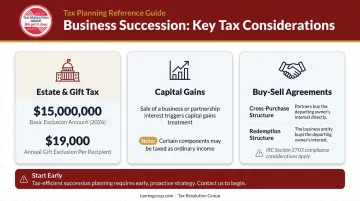
For family businesses and closely held private companies, the tax implications of transferring ownership can be substantial:
- Estate and gift taxes: The IRS basic exclusion amount is $15,000,000 for 2026, with an annual gift exclusion of $19,000 per recipient. Transfers above these thresholds trigger tax exposure that requires advance structuring
- Capital gains: Selling a partnership or business interest generates capital gains treatment, though some components may be taxed as ordinary income depending on the assets involved
- Buy-sell agreements: Cross-purchase and redemption structures each carry different tax treatment and need to be reviewed under current IRS rules, including Section 2703 valuation provisions
The consistent message from tax professionals: start early. Tax planning around a business exit is not something to address in the final months. Done reactively, these decisions can cost hundreds of thousands of dollars in avoidable liability. Done proactively, they can preserve more of the business's value at transfer.
Treat the succession plan as a living document. Review it with legal counsel and financial advisors whenever ownership structure, leadership composition, or business value changes materially — not just once at inception.
Common Succession Planning Challenges and How to Overcome Them
The Most Frequent Obstacles
| Challenge | Root Cause | Practical Fix |
|---|---|---|
| Leadership resistance | Current leaders avoid discussing their own exit | Frame planning as organizational strength, not personal departure |
| No internal candidates | Under-investment in development over time | Start development programs two to five years before anticipated need |
| Attrition during development | High-potentials leave if growth feels slow | Communicate development status clearly; accelerate timelines where possible |
| Plan becomes shelf-ware | No accountability for ongoing updates | Assign ownership, set annual review dates, tie metrics to leadership KPIs |
Objectivity vs. Internal Politics
When succession decisions are shaped by who a senior leader likes rather than who is genuinely ready, two things happen: the wrong person gets promoted, and the right people leave. Gallup research shows that status quo bias and confirmation bias are common distortions in succession decisions. Structured competency assessments, behavioral interviewing frameworks, and documented evaluation criteria push decisions toward consistent standards rather than personal preference — and make it harder to rationalize the wrong choice after the fact.
The Cost of Waiting
McKinsey describes CEO succession in family businesses as an 8-to-15-year journey, including five to ten years to identify, prepare, and evaluate successors. Organizations that wait until a vacancy is imminent don't have that runway.
Reactive external hires come with real costs:
- An estimated 18% salary premium over internal candidates
- Up to two years of lower performance while the new hire acclimates
- Lost institutional knowledge that a prepared internal successor would have brought from day one
Starting early isn't just good practice — it's what keeps those costs off the table entirely.
Frequently Asked Questions
What is leadership development and succession planning?
Succession planning is the process of identifying which leadership roles need future successors and who should fill them. Leadership development is the work of building those individuals' capabilities so they're genuinely ready when the time comes. The two function as a system — one without the other produces either a name on a list or training with no clear destination.
What are the 5 steps of succession planning?
The five steps are: assess future leadership needs, identify high-potential successors, develop targeted talent programs, plan and communicate transitions, and continuously review and adjust the plan. Each step builds on the previous one, and the process repeats as business priorities evolve.
What are the 5 D's of succession planning?
The 5 D's are the triggering events that can force an unplanned leadership or ownership transition: Death, Disability, Divorce, Disagreement, and Distress. Each represents a scenario where the absence of a succession plan causes maximum damage — which is why building one before any of these occur is essential.
What are the 7 C's of leadership?
The 7 C's is a leadership readiness framework covering Competence, Courage, Communication, Credibility, Commitment, Consistency, and Character. It's used to evaluate whether a potential successor has the full range of attributes a role demands — not just technical skills, but the behavioral traits that distinguish effective leaders.
When should a business start succession planning?
As early as possible — ideally years before any anticipated leadership change. Even small businesses and startups benefit from a basic framework. The organizations that wait until a departure is imminent face the steepest disruption and the fewest options.
How does succession planning differ for small businesses and family businesses?
Small and family businesses often have fewer internal candidates, making early development investment critical. Family businesses carry added complexity — leadership decisions are rarely just professional, and ownership transfers involve real tax and valuation consequences that require financial and legal planning well before any transition occurs.