The distinction matters because both services fill different roles at different stages. Bookkeeping keeps your financial records accurate and current. Accounting takes those records and turns them into strategy, compliance, and insight. According to Clutch, 45% of small businesses employ neither a bookkeeper nor an accountant — which means nearly half are flying financially blind.
This article explains what each service does, where they diverge, and how to decide which one your business actually needs right now.
Key Takeaways
- Bookkeeping records daily transactions; accounting interprets them for decisions and compliance
- Accountants hold degrees and CPA/CMA credentials — bookkeepers typically enter through certification or on-the-job training
- The BLS reports median accountant wages at $81,680 vs. $49,210 for bookkeeping clerks
- Most growing businesses need both, not one or the other
- IRS failure-to-file penalties reach up to 25% of unpaid tax — a risk that proper accounting helps eliminate
Bookkeeping vs. Accounting: Quick Comparison
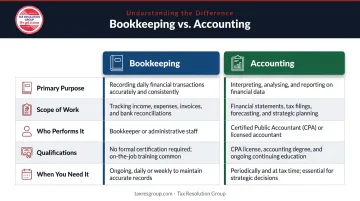
Bookkeeping is tactical and transactional. Accounting is strategic and analytical. Here's how they compare across the dimensions that matter most:
| Dimension | Bookkeeping | Accounting |
|---|---|---|
| Primary Purpose | Record and organize daily transactions | Interpret, analyze, and report financial data |
| Scope of Work | Data entry, reconciliation, ledger maintenance | Financial statements, tax planning, forecasting, compliance |
| Who Performs It | Bookkeeper or trained staff | CPA, CMA, or licensed accountant |
| Qualifications | Certification or on-the-job training | Degree, CPA/CMA designation, ongoing CPE |
| When You Need It | From day one of business operations | As financial complexity grows or tax/compliance needs arise |
Most businesses need both — bookkeeping as a foundation, accounting to act on what that foundation reveals.
What Is Bookkeeping?
Bookkeeping is the systematic process of recording, categorizing, and organizing a business's daily financial transactions. Without clean books, financial statements become unreliable, tax prep turns into a scramble, and cash flow visibility disappears entirely.
As Britannica defines it, bookkeeping is "the recording of the monetary values of business transactions" — it provides the raw information from which accounts are prepared.
Core Bookkeeping Tasks
The SBA identifies these as the essential day-to-day functions a bookkeeper handles:
- Recording transactions — sales, purchases, payments, and receipts posted to the correct accounts
- Accounts payable and receivable — managing what you owe vendors and what customers owe you
- Bank reconciliation — matching your internal records against bank statements to catch discrepancies
- Payroll processing — calculating wages, withholdings, and related tax obligations
- General ledger maintenance — the running record of all financial activity in the business
Accurate bookkeeping gives you real-time cash flow visibility, keeps records audit-ready, and reduces errors when tax season arrives. The IRS is direct on this point: good records help you identify deductible expenses, prepare accurate returns, and substantiate items if you're ever questioned.
Tools and Technology
Most bookkeepers today work in cloud-based platforms. QuickBooks remains the most widely used tool among small businesses — automating data entry, syncing bank feeds, and making reconciliation faster. Tax Resolution Group provides QuickBooks setup, training, and ongoing support — whether a business is configuring the system for the first time or correcting a backlog of disorganized records.
Who Benefits Most from Bookkeeping
Standalone bookkeeping is the right fit for:
- Early-stage startups and sole proprietors building their first financial processes
- Small businesses with straightforward transaction volumes
- Companies that need current, accurate records without complex tax or reporting needs
For instance, a tile retailer tracking daily sales and vendor invoices, a cabinet installation business managing subcontractor payments, or a new media company logging monthly expenses all share the same starting point: they need clean, consistent books before anything else makes sense.
What Is Accounting?
Accounting takes the data bookkeeping produces and transforms it into insight. Bookkeeping records what happened; accounting determines what it means and what to do next.
The IMA defines management accounting as "partnering in management decision making, devising planning and performance management systems, and providing expertise in financial reporting and control." That's a fundamentally different scope than recording transactions.
Core Accounting Responsibilities
Per the BLS, accountants and auditors:
- Examine financial statements for accuracy and regulatory compliance
- Compute taxes owed and prepare tax returns
- Inspect account books and systems for efficiency and fraud risk
- Provide management with financial analysis and recommendations
- Prepare budgets and financial forecasts
The strategic value goes beyond compliance. Accountants help business owners understand the why behind the numbers, from identifying cost-saving opportunities and evaluating hiring decisions to building the financial credibility that lenders and investors expect.
Credentials That Distinguish Accountants
That strategic scope is backed by credentials bookkeepers don't hold:
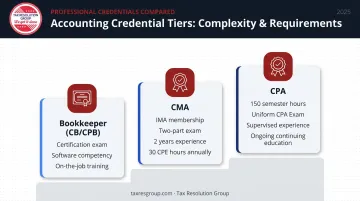
- CPA: Requires 150 semester hours of education, passage of the Uniform CPA Exam, supervised experience, and ongoing continuing education
- CMA: Requires IMA membership, a two-part exam, 2 years of professional experience, and 30 hours of CPE annually
- Bookkeeper certifications (AIPB CB / NACPB CPB): Validate transaction and software competency, which is a different standard than the analytical judgment CPA and CMA designations require
When Accounting Becomes Necessary
Accounting services become critical when:
- Your business is growing and financial complexity is increasing
- You're navigating multi-state tax obligations or industry-specific compliance
- You need financial statements for a lender, investor, or audit
- You're preparing for a business sale, merger, or valuation
- Tax disputes or IRS issues require professional representation
Tax Resolution Group provides financial statement compilations, strategic tax planning, IRS audit representation, and business valuations, services that address exactly the situations where professional accounting judgment matters most.
Bookkeeping vs. Accounting: 5 Key Differences
1. Scope of Work
Bookkeeping is backward-looking: it records what happened. Accounting is forward-looking: it interprets what those records mean and guides what happens next.
For instance, recording a $4,000 vendor payment is bookkeeping. Analyzing whether that expense category is growing faster than revenue — and recommending a renegotiation or vendor switch — is accounting.
2. Level of Analysis
Bookkeepers focus on accuracy and completeness. Accountants apply financial analysis, trend identification, and benchmarking to generate strategic insight.
For business planning, that distinction matters. Clean books tell you where money went. Accounting tells you whether that spending is sustainable.
3. Financial Reporting
| Bookkeeping Produces | Accounting Produces |
|---|---|
| Trial balances | Income statements |
| Basic profit and loss summaries | Balance sheets |
| Transaction records | Cash flow statements |
| Reconciliation reports | Audit-ready financial packages |
Accounting-level financial statements meet regulatory and stakeholder requirements that basic bookkeeping reports don't satisfy.
4. Decision-Making Involvement
Bookkeepers rarely sit at the strategy table. Accountants are often directly involved in major decisions: tax structure, capital allocation, whether to add headcount, business valuation, and entity restructuring. At these moments, professional judgment drives the outcome. Record accuracy alone isn't enough.
5. Cost and Credentials
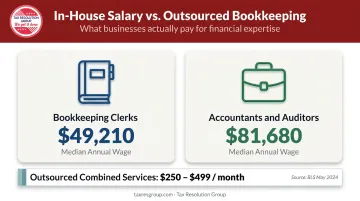
The credential gap translates directly to cost. BLS data from May 2024 puts the median annual wage for bookkeeping clerks at $49,210 versus $81,680 for accountants and auditors.
For outsourced services, a 2025 Ignition pricing report (covered by CPA Practice Advisor) found the most common monthly range for combined bookkeeping and accounting services was $250–$499/month — though pricing varies significantly based on scope, complexity, and the credentials involved. Accounting engagements with tax planning, financial statements, or advisory work typically sit at the higher end or beyond that range.
Which Service Does Your Business Need?
Bookkeeping Alone Is Often Enough When:
- Your transaction volume is manageable and relatively routine
- You have limited compliance complexity (no multi-state operations, straightforward payroll)
- You're early-stage with a tight budget and want hands-on involvement in daily finances
- Your primary need is clean, current records — not strategic interpretation
You Need Accounting — or Both Together — When:
- Revenue is growing and your financials are getting harder to interpret on your own
- You're dealing with multi-state tax obligations, payroll tax complexity, or industry-specific compliance
- A lender, investor, or potential buyer is requesting financial statements
- You're preparing for a business sale, merger, or valuation
- You've received an IRS notice or are facing a tax dispute
If you need records kept clean and current, start with bookkeeping. If you need to understand what those records mean for your future, you need accounting. Most growing businesses reach a point where both work in tandem.
Tax Resolution Group provides both services — bookkeeping support and accounting services tailored to SMEs, startups, and industry-specific businesses in Huntington Beach and beyond. You can start with clean recordkeeping and layer in tax planning, financial statements, or advisory services as your needs evolve.
Conclusion
Bookkeeping and accounting aren't competing services — they're complementary layers of financial management. Bookkeeping lays the foundation; accounting turns that foundation into strategy. The right combination depends on where your business stands today and where you want to take it.
Accurate books prevent costly errors and tax exposure. Strong accounting drives smarter decisions and sustainable growth. If you're unsure which level of support your business needs, Tax Resolution Group offers both bookkeeping and accounting services — so you can get the right help without outgrowing your provider.
Frequently Asked Questions
What is the difference between bookkeeping and outsourced accounting?
Bookkeeping records and organizes daily financial transactions: sales, payments, reconciliations, and payroll. Outsourced accounting goes further — credentialed professionals interpret that data to deliver financial analysis, tax planning, regulatory compliance, and strategic advisory on an ongoing basis.
Can a bookkeeper do accounting work?
Bookkeepers handle foundational tasks well: transaction recording, reconciliations, and ledger maintenance. They are generally not qualified to prepare certified financial statements, advise on complex tax strategy, or perform the analysis that licensed CPAs and CMAs provide.
Do small businesses need both a bookkeeper and an accountant?
Many do. Bookkeeping keeps day-to-day records accurate; accounting ensures compliance and supports growth planning. Some firms, including Tax Resolution Group, offer both services together, making it a practical, cost-effective option for businesses that need comprehensive financial coverage.
What tasks are included in bookkeeping services?
Core bookkeeping includes recording financial transactions, reconciling bank statements, managing accounts payable and receivable, processing payroll, and maintaining the general ledger. Some providers also include basic profit and loss summaries and cash flow tracking.
How do I know when my business needs accounting services?
Key signals: growing transaction complexity, difficulty understanding your financial reports, upcoming audits or tax filings, plans for expansion or a business sale, multi-state operations, or a need for strategic financial guidance beyond basic record-keeping.
Is it cheaper to outsource bookkeeping or hire an in-house bookkeeper?
Outsourcing is often more cost-effective for SMEs. In-house hiring carries salary, benefits, and payroll taxes — BLS data shows benefits alone average 30% of total compensation costs. Outsourcing eliminates that overhead, scales with your needs, and gives you access to a team rather than a single employee.