The stakes are high. According to the Federal Reserve's 2025 Small Business Credit Survey of 7,653 employer firms, 51% dealt with uneven cash flows and 56% struggled to pay operating expenses—problems that accurate, timely bookkeeping directly addresses.
This guide breaks down both models so you can make the right call for your business.
Key Takeaways
- Local bookkeeping offers in-person access and regional tax knowledge, but typically costs more and scales poorly
- Virtual bookkeeping cuts overhead through subscription pricing and cloud-based workflows, making it a strong fit for growing or remote-first businesses
- Cost, business complexity, industry type, and your comfort with digital tools are the primary decision factors
- A hybrid model combining virtual day-to-day bookkeeping with local or CPA-level tax strategy suits many small businesses well
- Businesses already using QuickBooks or similar tools often find virtual bookkeeping a natural fit
Local vs. Virtual Bookkeeping: A Quick Comparison
| Factor | Local Bookkeeping | Virtual Bookkeeping |
|---|---|---|
| Cost | $250–$1,000+/month | $199–$599+/month |
| Accessibility | In-person, walk-in | Remote via cloud tools |
| Technology | Varies by provider | Cloud-native (QuickBooks, Xero) |
| Local Tax Knowledge | Strong—embedded in the region | Varies; verify before hiring |
| Scalability | Limited without added staff | Built to scale by tier |
| Communication | Face-to-face meetings | Email, video, portal |
Cost context: Pricing varies by service scope, transaction volume, and payroll complexity.
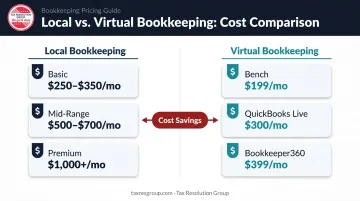
- Local bookkeeping: ~$250–$350/month (basic), $500–$700/month (mid-range), $1,000+/month (premium)
- Virtual bookkeeping: Bench from $199/month, QuickBooks Live from $300/month, Bookkeeper360 from $399/month
What Is Local Bookkeeping?
Local bookkeeping means hiring a professional—an individual or firm—who operates in the same geographic area. The arrangement allows for in-person meetings, physical document review, and a relationship built through direct, ongoing contact.
The practical advantages go beyond preference:
- Walk in when something needs urgent attention — no ticket, no wait
- Hands-on document handling for businesses running paper-heavy workflows
- Familiarity with state, city, and county-specific filing rules built from working in your market
- Deeper financial oversight that develops through consistent, face-to-face contact over time
When Local Bookkeeping Makes the Most Sense
Local bookkeeping is the stronger fit when your business involves complexity that benefits from physical oversight. The IRS Retail Audit Technique Guide emphasizes the importance of daily cash reconciliation, physical inventory counts, and internal controls in retail environments—all areas where an in-person bookkeeper can catch discrepancies faster.
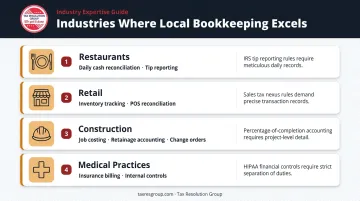
Industries where local bookkeeping tends to dominate:
- Restaurants and food service — high cash volume, daily reconciliation, tip reporting
- Retail shops — inventory tracking, shrinkage, POS reconciliation
- Construction contractors — job costing, subcontractor records, progress billing, retainages
- Medical practices — insurance billing complexity and internal control requirements
For construction specifically, the IRS Construction Industry Audit Technique Guide identifies job cost allocation, change orders, and retainage accounting as areas requiring close, detailed tracking—exactly the kind of work that benefits from proximity and hands-on review.
The compliance complexity in these industries points to a broader advantage. A bookkeeper embedded in your region knows whether your city levies a local business tax, what California's payroll deposit schedule requires, or which county forms are due at year-end. A virtual provider without that regional focus may simply not know what to look for — and jurisdiction-specific obligations don't announce themselves.
What Is Virtual Bookkeeping?
Virtual bookkeeping delivers the same core financial management—transaction categorization, bank reconciliation, payroll, financial reporting—through cloud-based platforms, with no physical presence required. The bookkeeper works remotely; you access everything through a secure online portal.
The practical benefits for small businesses:
- Lower cost structure — no overhead for office space or commute factored into your rate
- Predictable monthly pricing — subscription tiers let you budget accurately
- Scalability on demand — add payroll, AR/AP, or weekly reporting without hiring someone new
- Real-time financial visibility — cloud platforms update continuously, so you're not waiting for a monthly in-person meeting to see your numbers
For businesses already using QuickBooks Online or similar platforms, this setup requires no new infrastructure—your bookkeeper works inside the tools you already have.
When Virtual Bookkeeping Excels
Virtual bookkeeping fits businesses that operate digitally, grow quickly, or prioritize cost efficiency. Research from CPA.com and AICPA PCPS found that 60% of U.S. Client Advisory Services practices now serve clients completely or mostly virtually, with 17% revenue growth in that service category. That growth reflects genuine client demand, not just provider preference.
Ideal scenarios for virtual bookkeeping:
- E-commerce operators managing multi-channel sales, payment platform integrations, and sales tax across states
- Service-based businesses with straightforward, recurring transaction types
- Remote-first companies without a physical office to anchor them to a local provider
- Multi-location or multi-state businesses — consistent reporting standards across locations
- Solopreneurs and small teams — cost efficiency matters when headcount is lean
If your business already runs on QuickBooks Online, Xero, or FreshBooks, virtual bookkeeping plugs directly into existing workflows with minimal setup. That said, virtual isn't the right fit for every business—some situations call for a local bookkeeper's hands-on presence.
Which Bookkeeping Model Is Right for Your Small Business?
There's no universal answer here. The right choice depends on transaction complexity, growth trajectory, budget, and how you prefer to communicate with your financial team.
The Cost Factor
Local bookkeeping at the mid-range level runs $500–$700/month, or $6,000–$8,400 annually. If you're considering an in-house hire, the Bureau of Labor Statistics reports a median annual wage of $49,210 for bookkeeping clerks—before benefits, payroll taxes, and software costs.
Virtual services cluster around $199–$399/month for entry-level plans. That's $2,400–$4,800 annually for comparable base services. For businesses with straightforward transaction volumes, the cost difference alone can justify the switch.
The Scalability Factor
Local bookkeepers scale by adding hours or staff—which usually means higher fees. Virtual providers scale through tiered pricing and add-on services. Bookkeeper360, for example, distinguishes between monthly and weekly bookkeeping cadences, with modular add-ons for payroll ($200/month), sales tax ($125/month), and AR/AP ($150/month). You pay for what you need, when you need it.
Situational Recommendations
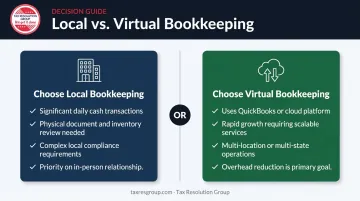
Choose local bookkeeping if:
- Your business handles significant cash transactions daily
- You require regular in-person document review or physical inventory oversight
- You operate in a highly regulated local environment with complex compliance requirements
- A direct personal relationship with your bookkeeper is a priority over cost savings
Choose virtual bookkeeping if:
- Your business already uses QuickBooks, Xero, or another cloud accounting platform
- You're growing quickly and need services that scale without proportional cost increases
- You operate across multiple locations or states and need consistent reporting
- Reducing overhead while maintaining accuracy is the primary goal
The Hybrid Option
Many small businesses use a hybrid model: a virtual bookkeeper handles day-to-day records, while a local CPA manages annual tax strategy, filings, and compliance. This approach gets the cost efficiency of virtual bookkeeping without sacrificing local tax expertise when it matters most.
Tax Resolution Group works this way, combining bookkeeping services with CPA-level tax planning and IRS resolution support so small business clients manage one relationship instead of two.
Real-world example: Bookkeeper360 documented its own shift from local, manual bookkeeping (where the founder traveled client to client manually inputting PDFs and statements) to a cloud-based workflow. The result: up to 130 hours saved per month through automated document handling and streamlined client delivery. Any small business switching from manual to cloud-based bookkeeping can expect a similar operational shift.
Conclusion
The better bookkeeping model isn't the one with more features — it's the one that matches how your business actually operates. If you handle heavy cash transactions, need physical document review, or deeply value in-person relationships, local bookkeeping is the more practical choice. If you're growing, cost-conscious, already working in the cloud, or managing operations across multiple locations, virtual bookkeeping offers meaningful advantages.
Start by auditing your current pain points: Are you overpaying? Underserved on reporting? Struggling with tax compliance? Your answers to those questions tend to make the decision straightforward.
Tax Resolution Group offers professional bookkeeping services—virtual and advisory—led by CPA professionals who help small business owners stay compliant, close their books accurately, and understand where their money is going. Contact the team at info@taxresgroup.com or (714) 657-3155 to discuss which model fits your business.
Frequently Asked Questions
What is the best bookkeeping method for a small business?
Double-entry bookkeeping is widely recommended for accuracy and scalability—it catches errors that single-entry systems miss. Pairing it with cloud accounting software like QuickBooks Online or Xero improves efficiency for most small businesses.
How much does a local bookkeeper cost compared to a virtual bookkeeper?
Local bookkeepers typically run $250–$700/month for basic to mid-range services, with premium packages exceeding $1,000/month. Virtual services generally start lower—$199–$399/month—with modular add-ons for payroll, sales tax, and AR/AP management.
Is virtual bookkeeping safe for small businesses?
Reputable virtual platforms use encrypted data storage, multi-factor authentication, and secure file transfer protocols. Intuit and Xero both publish documented security practices including MFA and activity monitoring. Still, vet providers individually rather than assuming all virtual services offer the same level of protection.
Can a virtual bookkeeper handle local tax compliance?
Many virtual bookkeepers understand state and local tax requirements, but depth varies. Businesses with complex multi-state nexus, local payroll tax districts, or unusual filing requirements should verify this expertise directly, and may benefit from pairing a virtual bookkeeper with a local CPA for those specific needs.
What software do virtual bookkeepers typically use?
The most common platforms are QuickBooks Online, Xero, FreshBooks, and Wave. Choosing a virtual bookkeeper who already works in the software your business uses ensures a smoother transition and eliminates data migration risk.
When should a small business switch from local to virtual bookkeeping?
Key triggers include rising bookkeeping costs, business growth that outpaces a local bookkeeper's capacity, expanding to multiple locations, or a desire for real-time financial reporting rather than monthly in-person updates.