
The issue usually isn't the bookkeeper's effort — it's that general bookkeeping and real estate bookkeeping require different things. Property-level P&L, Schedule E support schedules, depreciation tracking, and 1099 management aren't standard general bookkeeping outputs. When they're missing, your CPA fills in the gaps at their billing rate.
This guide covers what "CPA-ready" actually means for real estate, which services deliver it, and what to look for when comparing providers.
Key Takeaways
- CPA-ready real estate books include property-level P&L, Schedule E schedules, depreciation records, reconciliations, and 1099 summaries — ready to file without rework.
- General bookkeepers often miss real estate-specific rules: security deposit liability treatment, repairs vs. improvements, and 1031 exchange documentation.
- Look for services that separate income and expenses by property — commingled books cost extra CPA hours at tax time.
- Options range from DIY software starting at $9/month to full-service firms charging $200+ per property monthly.
- QuickBooks-based bookkeeping reduces handoff friction for most CPA engagements.
What Makes Real Estate Bookkeeping "CPA-Ready"?
"CPA-ready" isn't an IRS-defined term, but it has a practical meaning: your records map income, expenses, assets, liabilities, and supporting documents directly to the categories a CPA needs for your return — without requiring reclassification first.
The Reports That Actually Matter
Real estate CPAs work from a specific set of documents. If these aren't in your year-end package, your CPA builds them from scratch:
- Property-level Profit & Loss statements — income and expenses broken out per property or unit, not lumped together
- Schedule E support schedules — IRS Schedule E captures rental income, advertising, maintenance, mortgage interest, management fees, taxes, insurance, depreciation, and other rental expenses per property
- Depreciation worksheets — residential rental property depreciates over 27.5 years under MACRS; each property needs a tracked basis, placed-in-service date, and accumulated depreciation
- Bank reconciliation summaries — confirming book balances match actual bank activity
- 1099-NEC/MISC tracking — contractors paid $600+ require 1099-NEC; property managers reporting rent to owners require 1099-MISC
Real Estate-Specific Rules That Trip Up General Bookkeepers
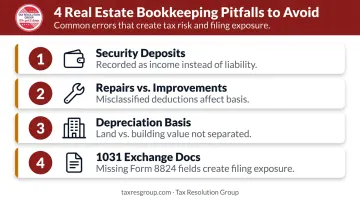
These four areas generate the most CPA corrections in real estate files:
- Security deposits — Under IRS Publication 527, security deposits held for return at lease end are liabilities, not income. Recording them as rental income creates a tax overstatement and a correction the CPA must unwind.
- Repairs vs. capital improvements — Repairs maintain existing condition (deductible in the current year). Improvements add value or extend useful life (capitalized and depreciated). The distinction affects both current deductions and long-term basis.
- Depreciation basis per property — Owners must separate land value (not depreciable) from building value and track original cost, improvements, and prior depreciation taken.
- 1031 exchange documentation — Form 8824 requires property descriptions, identification dates, transfer dates, adjusted basis, liabilities assumed, and cash/boot tracking. Missing any of these creates filing exposure.
Software Compatibility
Most CPAs work in QuickBooks Online or accept QBO-compatible exports. When a bookkeeper maintains records in a different system — or in spreadsheets — the CPA either re-enters data manually or spends staff time to convert files. QuickBooks-based bookkeeping eliminates that conversion entirely, cutting billable prep time before your return is even started.
Practically, that compatibility means:
- Chart of accounts structured to mirror Schedule E categories
- Exportable reports in formats CPAs can open directly (QBO, Excel, PDF)
- Clean transaction records with no manual reclassification required
Best Real Estate Bookkeeping Services with CPA-Ready Reports
These services were evaluated based on real estate expertise, quality of financial deliverables, software compatibility, and client trust.
Tax Resolution Group
Tax Resolution Group is a comprehensive tax and accounting firm based in Huntington Beach, CA, serving small businesses, real estate investors, and property owners. The firm's QuickBooks expertise covers setup, training, and ongoing support — enabling real-time financial data and organized records structured to hand off directly to a CPA.
The firm combines bookkeeping depth with a tax resolution background — books are built with IRS compliance in mind from the start, not retrofitted before filing season. Real estate owners who want bookkeeping and tax advisory under one roof get records that arrive at the CPA already structured for filing, without the back-and-forth.
| Category | Details |
|---|---|
| Key Features | QuickBooks setup, training, and ongoing support; real-time financial data; property-level tracking; CPA-ready monthly reports; tax resolution and advisory services |
| Pricing | Contact Tax Resolution Group directly for customized pricing based on portfolio size and service scope; available Mon–Sat 9AM–5PM at (714) 657-3155 |
| Best For | Real estate investors and small business owners who want QuickBooks-based bookkeeping aligned with CPA and tax resolution workflows |
1-800Accountant
1-800Accountant is a national virtual accounting firm with dedicated bookkeepers familiar with rental property expenses, commission income structures, and quarterly estimated taxes.
Their flat-fee model provides predictable monthly costs, and the Core Accounting+ tier includes a dedicated bookkeeper plus full-service bookkeeping on top of tax preparation and advisory — making it a true all-in-one option for smaller portfolios.
| Category | Details |
|---|---|
| Key Features | Dedicated bookkeeper, monthly reconciliation, financial reporting, 1099 filing support, payroll, year-round tax advisory, audit defense |
| Pricing | Tax Advisory: $209/month; Core Accounting: $249/month; Core Accounting+: $419/month (all billed annually) |
| Best For | Solo landlords and small portfolio owners who want bundled bookkeeping and tax filing with flat-fee pricing |
Hall CPA (The Real Estate CPA)
Hall CPA focuses exclusively on real estate investors, integrating accounting directly into a broader tax strategy practice. Their bookkeepers understand advanced investor strategies — Real Estate Professional Status, the short-term rental loophole, cost segregation, and bonus depreciation — which means the books they maintain are already structured to support those positions at filing.
For complex investor situations, this distinction is meaningful. A bookkeeper who doesn't understand REPS can't structure records to support that election — and no amount of year-end cleanup fixes records that were never organized around it.
| Category | Details |
|---|---|
| Key Features | Real estate-specific accounting, depreciation tracking, Schedule E support, tax advisory, cost segregation coordination, investor-focused reporting |
| Pricing | Minimum tax prep fee: $1,500 (with active advisory or bookkeeping); average landlord: $3,000–$5,000; bookkeeping approximately $200/property/month; 12-month tax strategy engagements up to $10,000 |
| Best For | Active investors with multi-property portfolios who need bookkeeping integrated with advanced tax planning |
REI Hub
REI Hub is purpose-built real estate accounting software — not a general bookkeeping platform adapted for landlords. The chart of accounts, report templates, and tax outputs were designed specifically for rental property investors.
Core features include:
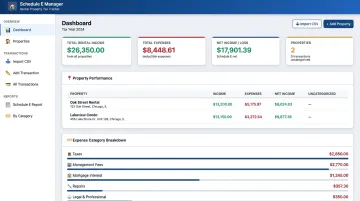
- Schedule E reports structured to mirror the IRS form format
- Property-level P&L by unit or full portfolio
- Vendor tracking for 1099 preparation (tracking only — does not file directly with the IRS)
- Fixed asset and depreciation tracking
- Bank reconciliation tools
Investors who self-manage their books in REI Hub arrive at tax season with CPA-compatible documentation already organized.
| Category | Details |
|---|---|
| Key Features | Real estate chart of accounts, Schedule E report, income/expense tracking by unit and property, 1099 vendor tracking, depreciation and asset basis tracking, bank reconciliation |
| Pricing | Free plan available; paid plans start at $9/month (annual) or $15/month for up to 3 units; up to $48/month (annual) for unlimited units |
| Best For | Self-managing landlords and small-portfolio investors who want structured, CPA-compatible records without full-service bookkeeping costs |
Steph's Books
Steph's Books specializes in property management companies with $1M–$10M in revenue, working inside clients' existing platforms — AppFolio, Buildium, and Yardi — rather than requiring system migration. For property managers with established PM workflows, that means no operational disruption.
Their core strength is trust accounting compliance: three-way reconciliation, per-property income and expense tracking, monthly owner statements, and 1099 e-filing. For property managers holding owner funds in trust, these deliverables are exactly what CPAs need to file returns for both the management company and individual property owners.
| Category | Details |
|---|---|
| Key Features | Trust accounting reconciliation, per-property income/expense tracking, monthly owner statements, 1099 e-filing, PM platform integration (AppFolio, Buildium, Yardi), catch-up bookkeeping |
| Pricing | Starting at $350/month; custom quotes based on unit count and portfolio scope |
| Best For | Property management companies managing 20–500+ units who need trust-compliant, CPA-ready monthly books |
How to Choose the Right Real Estate Bookkeeping Service
Most investors make the same mistake when searching for a bookkeeper: they evaluate on price and availability, then discover months later that the records aren't structured for real estate tax filing. By that point, the CPA is already billing to fix it.
Core Evaluation Criteria
Real estate experience — Verify that the bookkeeper understands trust accounting, depreciation under MACRS, 1099 requirements, and security deposit liability treatment. Ask directly: "How do you handle capital improvements vs. repairs?" The answer reveals competence quickly.
Software compatibility — Confirm whether records are maintained in QuickBooks Online or exported in a QBO-compatible format. If your CPA uses QBO and your bookkeeper doesn't, you're paying someone to do conversion work on the back end.
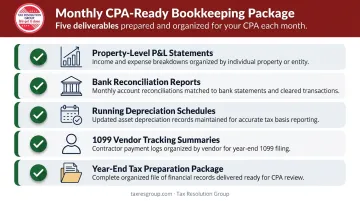
Monthly deliverable quality — Ask for a sample of what you receive each month. A strong real estate bookkeeping package includes:
- Property-level P&L statements
- Bank reconciliation reports
- Running depreciation schedules
- 1099 vendor tracking summaries
- Year-end tax preparation package
Pricing transparency — Full-service bookkeeping for real estate varies based on transaction volume and portfolio size. Get specifics on what's included at each tier, and confirm whether 1099 filing and year-end reports are bundled or billed separately.
Additional Factors Worth Checking
These factors often separate reliable long-term partners from providers who work fine until your situation gets more complex.
- Responsiveness — Transactions move fast. Slow turnaround on a closing question can create real downstream problems.
- Scalability — Confirm the service can handle growth from 3 properties to 15 without forcing a provider switch.
- Proactive tax readiness — Strong services flag issues quarterly, not in March. Ask whether mid-year check-ins are included in the engagement.
Conclusion
The right real estate bookkeeping service doesn't just track transactions — it delivers financials your CPA can act on immediately. CPA-ready reports are the clearest measure of whether a provider is actually doing that job.
When evaluating providers, look past the monthly fee and ask specifically: What reports do you deliver each month? Are they formatted for Schedule E? How do you handle depreciation tracking and 1099s? Those questions separate general bookkeepers from real estate specialists.
Tax Resolution Group meets those criteria directly. Real estate investors and property owners who want QuickBooks-based bookkeeping structured for direct CPA handoff can reach the firm at (714) 657-3155, Monday through Saturday, 9AM–5PM, or by email at info@taxresgroup.com. QuickBooks proficiency, a tax resolution background, and hands-on small business accounting experience make it a grounded choice for investors who need books that are genuinely filing-ready.
Frequently Asked Questions
What do most CPAs charge per hour?
According to the 2025 National MAP Survey, the median net hourly billing rate at CPA firms was $170 in fiscal year 2024, with senior roles billing $198–$275 per hour. Disorganized records extend CPA prep time before filing can begin, increasing your bill proportionally.
Does bookkeeping have to be done by a CPA?
No — bookkeeping and CPA work are separate functions. A licensed CPA is not required to maintain day-to-day records, but the bookkeeper's output must be accurate and properly categorized for a CPA to prepare and file returns without additional cleanup.
What is the best bookkeeping software for real estate investors?
QuickBooks Online is the most widely used option for its flexibility and CPA compatibility. REI Hub is purpose-built for landlords, generating Schedule E reports and property-level financials natively, making it the stronger fit for investors who want real estate-specific reporting from day one.
What reports should real estate bookkeeping services deliver for tax season?
At minimum: property-level P&L statements, Schedule E support schedules, depreciation worksheets, bank reconciliation summaries, and 1099-NEC/MISC summaries for any contractor or property owner paid $600 or more during the year.
What is the difference between a bookkeeper and a CPA for real estate?
A bookkeeper maintains ongoing financial records — categorizing income and expenses, reconciling accounts, and tracking assets. A CPA uses those records to prepare tax returns, advise on tax strategy, and represent clients before the IRS. Both roles are necessary; neither replaces the other.
How much do real estate bookkeeping services typically cost per month?
DIY software like REI Hub starts at $9/month for small portfolios, while full-service bookkeeping typically runs $350–$500/month. Costs increase based on transaction volume, number of properties, and whether tax filing or advisory services are included.