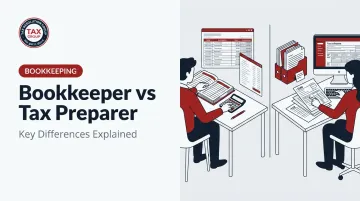
Both roles matter. But they serve different purposes. A bookkeeper keeps your financial records accurate and current throughout the year. A tax preparer takes those records and translates them into compliant, strategically filed tax returns. One builds the foundation; the other works with it.
Understanding which professional you need—and when—can save you money, reduce errors, and set your business up for cleaner finances year-round.
Key Takeaways
- Bookkeepers record and organize financial transactions year-round; tax preparers use that data to file accurate, compliant returns
- Tax preparers are typically engaged seasonally, while bookkeepers handle ongoing financial recordkeeping
- Any paid tax preparer must hold an IRS-issued PTIN; bookkeepers have no mandatory federal license
- Most businesses need both—clean books make tax prep faster, cheaper, and more accurate
- Gaps between the two roles lead to filing errors, missed deductions, and compliance risk
Bookkeeper vs Tax Preparer: Quick Comparison
| Dimension | Bookkeeper | Tax Preparer |
|---|---|---|
| Primary Role | Record and organize financial transactions | Prepare and file tax returns |
| Core Responsibilities | Data entry, bank reconciliation, payroll, A/P and A/R, financial reports | Return preparation, deduction identification, estimated taxes, tax planning |
| Timing | Year-round, ongoing | Seasonal or periodic (January–April primarily) |
| Federal Requirement | No mandatory license | Must hold a valid IRS PTIN |
| Common Credentials | AIPB Certified Bookkeeper, NACPB CPB, QuickBooks ProAdvisor | CPA, Enrolled Agent, Tax Attorney, AFSP participant |
| Typical Cost | Lower hourly rate, continuous engagement | Higher per-engagement rate, less frequent |
| Reports To | Business owner | Business owner + IRS compliance standards |
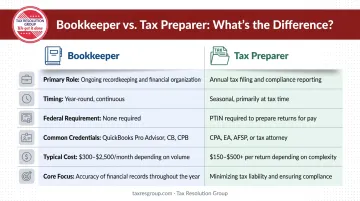
These roles are complementary, not interchangeable. Some firms, including Tax Resolution Group in Huntington Beach, offer both services under one roof — which means your financial records and tax filings stay in sync without handoffs between separate providers.
What Is a Bookkeeper?
Bookkeeping is the systematic process of recording, categorizing, and organizing a business's daily financial transactions—sales, purchases, payroll, receipts, and payments. It's a transactional function, not an advisory one. These records form the financial foundation everything else depends on.
Core Day-to-Day Responsibilities
A bookkeeper typically handles:
- Recording transactions in accounting software such as QuickBooks
- Reconciling bank and credit card statements monthly
- Managing accounts payable and receivable
- Processing payroll and related filings
- Generating financial reports—profit & loss statements, balance sheets, cash flow summaries
This ongoing work creates the financial record that feeds directly into your tax return and any financial decisions you make throughout the year.
Credentials: Voluntary, Not Mandatory
The Bureau of Labor Statistics confirms that licenses and certifications are not usually required for bookkeeping roles. That said, voluntary credentials do signal competence and professionalism:
- AIPB Certified Bookkeeper (CB): Requires a 4-part national exam, two years of full-time bookkeeping experience (or 3,000 hours part-time), and a signed Code of Ethics—with 60 hours of continuing education every three years to maintain
- NACPB Certified Public Bookkeeper (CPB): Validates knowledge across bookkeeping, payroll, accounting, and QuickBooks Online
- QuickBooks ProAdvisor: Free certification through Intuit's ProAdvisor Academy, updated annually
None of these credentials authorize a bookkeeper to prepare or file tax returns for compensation.
When Does a Business Need a Bookkeeper?
The moment a business opens, there are transactions to track, expenses to categorize, and cash flow to monitor. Waiting until tax season to get organized almost always costs more—either in accountant hours cleaning up the mess, or in missed deductions that require accurate records to claim.
The real value of a bookkeeper is continuous visibility. Clean, current books show whether you're profitable, where cash is going, and whether you can afford that next hire or equipment purchase. You get answers in real time, not at year-end.
What Is a Tax Preparer?
A tax preparer compiles financial information, prepares tax returns, and files them on behalf of individuals or businesses. Their primary obligations are accuracy, legal compliance, and sound tax positioning under federal and state law.
Core Responsibilities
- Preparing and filing income, payroll, and applicable business tax returns
- Identifying eligible deductions and credits
- Calculating estimated quarterly tax payments
- Advising on tax planning strategies
- Representing clients before the IRS in audits, notices, or collections (depending on credential level)
Credentials and Representation Rights
The IRS requires that anyone who prepares or assists with federal tax returns for compensation must hold a valid Preparer Tax Identification Number (PTIN). But not all credentialed preparers carry the same authority:
| Credential | IRS Representation Rights |
|---|---|
| Enrolled Agent (EA) | Unlimited—audits, collections, appeals |
| CPA | Unlimited—audits, collections, appeals |
| Tax Attorney | Unlimited—audits, collections, appeals |
| AFSP Participant | Limited—for returns they prepared and signed |
| PTIN only (no credential) | Return preparation only; no representation rights after Dec. 31, 2015 |
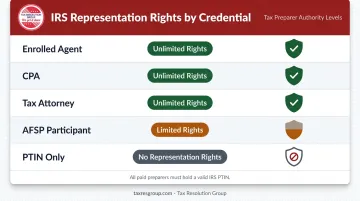
If your business might face an audit, a payment dispute, or any IRS notice, the credential level of your preparer matters. You can verify preparer credentials through the IRS Directory of Federal Tax Return Preparers.
Timing and Engagement
Tax preparers are most active from January through April for individual and business filings. However, complex business situations—multiple entities, major acquisitions, payroll tax issues—call for year-round tax planning rather than a one-time annual filing engagement.
Tax Resolution Group's team includes Tony Forsythe, EA, an Enrolled Agent with over 25 years of experience across tax planning, preparation, and audit resolution. As an Enrolled Agent, he holds unlimited IRS representation rights—covering audits, collections, and appeals—so clients have direct representation if an IRS issue arises.
Bookkeeper vs Tax Preparer: Key Differences Explained
Role Focus
A bookkeeper's work is transactional and present-tense: recording what happened financially, accurately and on time. A tax preparer's work is compliance-driven and strategic: determining how that financial history translates into tax obligations and finding every legal way to reduce them.
These aren't competing functions—they're sequential ones.
Timing and Interdependence
Bookkeepers work continuously. Tax preparers step in at filing time (or for periodic planning). The relationship between them is direct: the better the bookkeeper's records, the faster and cheaper the tax preparer's job becomes.
Disorganized books mean a tax preparer must spend billable hours reconstructing what a bookkeeper should have maintained all year. That's a cost the business absorbs—and it's entirely avoidable.
Certification and Legal Authority
This is where the distinction becomes a compliance issue:
- Bookkeepers have no federal licensing requirement. Voluntary credentials from AIPB or NACPB signal competence but confer no regulatory authority
- Tax preparers must register with the IRS and maintain a valid PTIN
- EAs, CPAs, and attorneys hold unlimited IRS representation rights—critical if a business faces an audit or collection issue
A bookkeeper who prepares tax returns for compensation without a PTIN is operating outside legal bounds.
Scope of Services
Bookkeepers do not provide tax advice or file returns. Tax preparers do not typically manage daily transaction recording. When these boundaries blur (or when one professional is expected to do both without proper credentials), compliance gaps open up.
Cost Differences
BLS data from May 2024 puts the median hourly wage for bookkeeping, accounting, and auditing clerks at $23.66 (median annual: $49,210). This reflects employee wages, not outsourced service rates, which vary by market and engagement model.
Tax preparer fees are harder to pin down. NSA and NATP publish survey data, but full fee benchmarks are typically behind paywalls. NATP's 2025 research shows 83% of tax preparers raise fees every one to two years, typically by 6–10%.
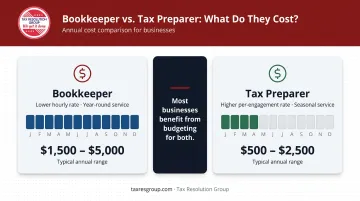
For most small businesses, the cost profile breaks down like this:
- Bookkeepers: lower per-hour cost, year-round commitment
- Tax preparers: higher per-engagement cost, used less frequently
- Total annual spend: broadly comparable across both roles, varying by credential level, form complexity, and business size
Which Financial Professional Does Your Business Need?
The honest answer for most businesses: both. But the sequencing matters.
Start with a Bookkeeper If:
- You're in the early stages of operations
- You're tracking cash flow and separating personal from business expenses
- You don't yet have employees or complex revenue streams
- Your financial records need structure before anything else
Add a Tax Preparer When:
- You have employees and payroll tax obligations
- You're managing multiple revenue streams or business entities
- You want strategic tax planning, not just annual filing
- You face (or want to avoid) IRS scrutiny
The Case for Both Under One Roof
When bookkeeping and tax preparation are handled by the same team, the handoff between functions is seamless. The professionals managing your day-to-day records already understand your financial picture when filing time arrives. No reconstruction, no data gaps, no scrambling to fill in the blanks before the deadline.
That's the model Tax Resolution Group uses with businesses in Huntington Beach and across California—bookkeeping, tax preparation, QuickBooks integration, and payroll support handled within a single engagement. Call (714) 657-3155 or email info@taxresgroup.com to discuss where your business stands and what support makes sense right now.
Frequently Asked Questions
What's the difference between a bookkeeper and a tax preparer?
A bookkeeper manages ongoing financial recordkeeping throughout the year—tracking transactions, reconciling accounts, and generating reports. A tax preparer uses those records to prepare and file returns, ensure compliance, and minimize tax liability. The two roles serve different purposes at different points in your financial calendar, and most businesses need both.
Can a bookkeeper prepare tax returns?
Not legally without an IRS-issued PTIN. Most bookkeepers are not licensed for tax return preparation. For complex filings, a CPA or Enrolled Agent is the appropriate credential. Some professionals hold dual qualifications; confirm credentials through the IRS's free PTIN directory before hiring.
Do I need both a bookkeeper and a tax preparer?
Most businesses benefit from both. The bookkeeper maintains organized records year-round; the tax preparer uses those records at filing time. Without accurate books, tax prep becomes slower, costlier, and more error-prone.
How much does a bookkeeper cost compared to a tax preparer?
Bookkeepers typically charge a lower hourly rate but work continuously. Tax preparers charge more per engagement but are used seasonally. Annual bookkeeping costs often run $1,500–$5,000 for small businesses; tax prep fees typically range from $500–$2,500 depending on complexity.
What certifications should I look for when hiring a tax preparer?
At minimum, any paid tax preparer must hold an IRS PTIN. Higher-tier credentials—Enrolled Agent, CPA, or Tax Attorney—indicate advanced expertise and grant full IRS representation rights, which matters if your business faces audits or complex tax issues.
When should a small business hire a bookkeeper versus a tax preparer first?
Hire a bookkeeper first to establish financial order from day one. Bring in a tax preparer once you have employees, multiple revenue streams, or tax obligations complex enough to require strategic guidance beyond basic filing.