Introduction
Accounting errors cost small businesses an average of $3,534 per year in tax overpayments — and that figure doesn't account for the inflated CPA fees, missed deductions, and payroll penalties that pile on when financial records fall behind.
Bookkeeping itself isn't expensive. Costs spiral when owners make poor setup decisions, let records accumulate without attention, or build financial operations that create unnecessary complexity.
Understanding where those spirals start requires a baseline. Small business bookkeeping typically runs $200–$2,500 per month for outsourced services, depending on transaction volume, business complexity, and service scope. Freelance bookkeepers charge $20–$90 per hour. Hiring in-house costs $70,000+ annually once benefits are factored in.
This guide examines bookkeeping costs through three specific lenses:
- Pre-engagement decisions — setup choices that lock in costs before work begins
- Day-to-day engagement management — how consistency (or lack of it) drives overages
- Surrounding financial systems — tools, integrations, and structural complexity that affect scope
Key Takeaways
- Outsourced bookkeeping costs $200–$2,500/month; most businesses under $5M revenue land in the $400–$800 range
- Cleanup bookkeeping commands a 50–150% hourly premium over routine monthly work — staying current is the single most effective cost control
- 75.1% of tax preparers charge more when client records are disorganized, averaging $145 in extra fees per return
- Transaction volume and account count drive costs non-linearly: 500 monthly transactions cost roughly 4x more to process than 50
- Businesses that integrate bookkeeping with tax prep under one provider eliminate duplicate data-organization work — reducing both prep time and billable hours at year-end
How Bookkeeping Costs Build Up
Most small business owners think of bookkeeping as a single monthly expense. It isn't. Costs accumulate across multiple layers — service fees, software subscriptions, ad hoc cleanup charges, and rework billed when records fall behind. The most damaging pattern is compounding neglect: one month of disorganized records creates two months of correction work.
The Backlog Penalty
A full year of deferred bookkeeping can produce cleanup bills that dwarf twelve months of routine service fees. The numbers bear this out:
| Months Behind | Estimated Catch-Up Cost |
|---|---|
| 1–3 months | $300–$500 |
| 4–6 months | $500–$1,500 |
| 7–12 months | $1,500–$3,500 |
| 2–3 years | $4,000–$15,000 |
Source: SDO CPA, 2026
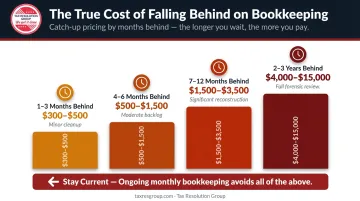
Catch-up work also commands a notable rate premium. Freelancers charge $50–$75/hour for backlog bookkeeping versus $20–$50/hour for routine work. CPA firms handling tax-sensitive cleanup bill $150–$300/hour.
Where the Hidden Costs Actually Show Up
The most damaging bookkeeping costs often don't appear as bookkeeping line items at all. They surface as:
- Inflated CPA fees — 75.1% of tax preparers charge more for disorganized records, averaging $145.14 extra per sole-proprietor return
- Delayed financial reporting — decisions made without accurate data
- Payroll errors — corrections that require additional professional hours
- Audit penalties — the IRS assessed nearly $13 billion in employment tax penalties in recent years
DIY bookkeeping typically costs 3–5x more in eventual tax-prep cleanup than professional monthly bookkeeping would have, a gap most owners don't recognize until they're already paying it.
Key Cost Drivers for Small Business Bookkeeping
Understanding what drives costs is more useful than comparing quoted rates. Four factors account for most of the variance in what small businesses actually pay.
Transaction Volume and Account Count
Transaction volume is the most direct cost multiplier in bookkeeping. According to Catalyst CPA's 2026 benchmarks:
- 500 monthly transactions cost approximately 4x more than 50 transactions
- Five bank or credit accounts require roughly 5x the reconciliation effort of a single account
Multi-channel businesses — those running revenue through an e-commerce platform, a point-of-sale system, and direct invoicing simultaneously — face compounding complexity from all three dimensions at once.
State of Existing Records
Businesses with incomplete or outdated books pay a "disorder premium" that stays invisible in normal months but surfaces sharply at the worst times:
- Onboarding a new bookkeeper or CPA (catch-up work billed at full rates)
- Applying for a loan or line of credit (lenders require clean financials)
- Filing taxes or responding to an IRS notice (disorganized records extend billable hours fast)
Clean, current records eliminate that premium entirely.
Accounting Method Choice
Cash-basis accounting records transactions when money changes hands — simpler, with fewer journal entries. Accrual accounting tracks receivables, payables, deferred revenue, and prepaid expenses, requiring more ongoing reconciliation at every close.
Under IRC Section 448, businesses with average annual gross receipts under $30 million generally qualify to use the cash method. Most small businesses can avoid accrual complexity entirely. Defaulting to accrual when cash-basis would suffice adds monthly cost without adding useful insight — and switching methods mid-operation requires IRS Form 3115 plus restating prior-period financials. The time to make this call is at the start.
Payroll, Sales Tax, and Entity Complexity
Each of these variables adds a distinct cost layer:
- Payroll: $30–$100 per employee per month for processing, plus $5–$15 per W-2 or 1099 generated
- Sales tax compliance: Retailers spend an average of 209 hours and $24,032 annually on compliance; manufacturers average 149 hours and $14,256
- Multi-entity or multi-state operations: Drive complexity that scales the bookkeeping workload significantly beyond what a simple fee comparison would suggest
Cost-Reduction Strategies for Small Business Bookkeeping
Cost reduction targets one of three leverage points: the decisions made before engaging a service, how the engagement is managed while active, or the operational systems surrounding it. Each subsection below addresses one of these levers — because a problem rooted in poor initial decisions won't be fixed through tighter day-to-day management alone.
Strategies That Change Decisions Upfront
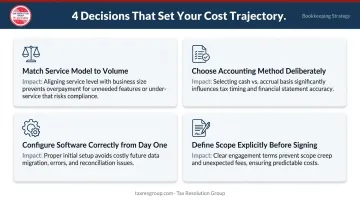
Most overspending on bookkeeping starts before the engagement begins. Four decisions made upfront set the cost trajectory for everything that follows:
- Match service model to volume. A freelancer suits low-volume businesses with simple financials. Outsourced firms deliver better economics at scale and built-in redundancy. In-house bookkeepers cost $70,000+ annually fully loaded (based on a $49,210 median BLS wage plus benefits); outsourcing equivalent work typically runs $6,000–$30,000 per year.
- Choose your accounting method deliberately. Defaulting to accrual without a business case for it adds ongoing cost. Cash-basis is simpler, cheaper to maintain, and appropriate for most businesses under $30M in revenue.
- Configure software correctly from day one. QuickBooks set up with the right chart of accounts, bank feed connections, and automation rules reduces billable hours each month. Fixing a misconfigured setup later runs $300–$2,000+ for cleanup — a cost that proper initial setup eliminates.
- Define scope explicitly before signing. Vague engagement agreements create unbounded billing. A documented list of monthly deliverables — reconciliations, financial reports, payroll entries — sets a predictable cost baseline and enables meaningful price comparison.
Tax Resolution Group's QuickBooks expertise covers initial setup, staff training, and ongoing ProAdvisor-level support, reducing the recurring correction costs that DIY configurations tend to produce.
Strategies That Improve How Bookkeeping Is Managed
The systems surrounding bookkeeping — payroll tools, banking structure, software automation — determine how much manual work lands on a bookkeeper's invoice each month.
Integrate payroll and expense management with bookkeeping. Businesses running these functions through disconnected tools generate manual data transfer work at every touchpoint. A unified or well-integrated setup reduces redundant entry and the categorization errors it creates. Tax Resolution Group offers payroll processing alongside bookkeeping and tax preparation, eliminating the data handoff friction that separate providers create.
Consolidate banking and payment accounts where possible. Every additional bank account, credit card, or payment processor adds reconciliation complexity. Reducing the number of accounts a bookkeeper must track each month produces a measurable reduction in monthly hours.
Automate recurring entries through bank feed rules. Manually categorizing recurring transactions — rent, utilities, subscriptions, loan payments — is labor that software handles automatically. QuickBooks' bank feed automation features, including batch categorization and custom rules, can save hours every month in repetitive data entry alone. It's a one-time setup that pays back every month.
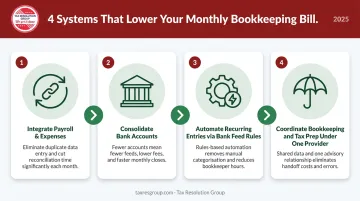
Coordinate bookkeeping and tax preparation through the same provider. Businesses using separate providers for each often pay for the same data organization work twice — the bookkeeper organizes it, the CPA reorganizes it. Tax Resolution Group handles both under one roof, which means tax-season preparation starts from already-clean, already-reconciled records rather than from scratch.
Conclusion
Real bookkeeping cost control starts with understanding where cost originates — in early structural decisions, in day-to-day record management, or in surrounding systems that make the bookkeeper's work harder than it needs to be.
The businesses that consistently spend the least on bookkeeping share a few traits: they made deliberate choices about service model and accounting method at the start, they maintain current records rather than batching work at year-end, and they've built financial systems that reduce complexity rather than adding to it.
Cost control in bookkeeping is strategic and continuous. If you want to reduce what you spend, start by auditing the decisions that came before the invoice.
Frequently Asked Questions
How much should a small business spend on bookkeeping?
Most small businesses spend $200–$2,500 per month on outsourced bookkeeping, with businesses under $5M in revenue typically falling in the $400–$800 range. The right amount depends on transaction volume, entity complexity, and whether cleanup or backlog work is involved at the start.
How much should a self-employed bookkeeper charge?
Freelance bookkeeper rates typically run $20–$90 per hour depending on experience, industry specialization, and software proficiency. Many offer fixed monthly packages — generally in the $200–$500 range — for small businesses with predictable, low-volume needs.
Is it cheaper to outsource bookkeeping or hire in-house?
In-house bookkeepers cost $70,000+ annually once benefits and overhead are factored in, based on a median wage of $49,210 and benefits averaging 30.1% of total compensation. Outsourced services typically run $6,000–$30,000 per year for equivalent output — a difference of $40,000 or more for most small businesses.
What are hidden bookkeeping costs small businesses often overlook?
The most commonly overlooked costs include:
- Cleanup and backlog fees when records fall behind
- Inflated CPA charges from disorganized records at tax time
- Software subscription costs
- Owner time spent on financial tasks (typically 20+ hours per month)
Can proper software setup reduce my bookkeeping costs?
Correct QuickBooks configuration — including a proper chart of accounts, bank feed connections, and automated categorization rules — directly reduces billable bookkeeper hours each month. Fixing a misconfigured setup after the fact typically costs $300–$2,000 or more, so getting it right from the start pays off quickly.
What is the difference between a bookkeeper and a CPA for small business purposes?
Bookkeepers handle day-to-day transaction recording, bank reconciliation, and financial reporting year-round, billing $20–$75 per hour. CPAs handle tax planning, filing, and IRS representation at $100–$400 per hour. Clean, current bookkeeping directly reduces CPA fees by eliminating the prep and cleanup work that disorganized records require at filing time.